Aneesh Sathe
Jan 14, 2025
January 14, 2025

Font fight! #
The fonts have assembled, their ligatures sharp their curves are shiny. They all line up with perfect kerning… or do they? Your eyes and mind are their battlefield.
I got JetBrains mono btw.
Decentralization is just partial centralization #
Renée DiResta writes about the social media flux in Noema.
Decentralization places a heavy burden on individual instance administrators, mostly volunteers, who may lack the tools, time or capacity to address complex problems effectively.
Identity verification is another weak point, leading to impersonation risks that centralized platforms typically manage more effectively. Inconsistent security practices between servers can allow malicious actors to exploit weaker links.
While all this is fine, I have a completely different view about the ongoings around social media. I’d rather completely quit something than go through the pain of sorting through and tuning the place just right.
The internet has infinite space. Make your own blog, follow people you like (RSS feeds still work!) and ignore those you don’t. Nostalgic about back when Twitter was good? Well there was a time when the internet was good. It was good because the people with access created little gardens of their own (not just of the digital garden variety, but those too). Psst… it’s still good btw, the social media blinds you.
While I’m a staunch early adopter I’m also an early abandoner. The only thing I’ve been unable to abandon is blogs. I’ve never felt like it’s was better to shut myself inside a walled garden, but I would suffocate if I weren’t able to surf, what a wonderful word that is, the internet.
Obsessing is happiness #
My happiest times have been when I was completely consumed by some task or project for days on end. I’ve learned hydropinics and grown an ungodly amount of mint in the Singapore Sun. I’ve made terrible mead, taught myself programming, then machine learning… countersteering a motorcycle? You should watch me lean.
All this to say that happiness is an entirely oblique activity. This was crystallized for me in this post about Betrand Russell’s Conquest of Happiness by the wholly awesome Maria Popova
The 1900s are here #
Every 24th frame of Stanley Kubrick’s masterpiece 2001: A Space Odyssey posted once an hour
That cools projects like these exist is a testament to the eternal cool of the Internet. As I write, the bot is on its 1,899th hour. The exciting 1900s are coming up.
If you are new to Bayesian Stats start here #
Jan 13, 2025 Life, platforms, vectors
January 13, 2025
Crystal-Bison #
I don’t want to give away much of the poem but it captures the nature, ferocity, and purpose of life.
Ghost Exits #
Aligning with the idea that blogs will be the last of the [good internet](http://Jan. 3, 2025) there is a broader question about platforms and their methods. Long before meta and X abandoned all pretense the internet was already under attack while we were believed this was fine.
We need more (and better) institutions and fewer platforms, and the latter have flourished at the expense of the former, advancing a specific agenda under an apolitical guise…
We depend on those platforms more because our institutions have weakened. The present arrangement was far from inevitable and need not be permanent.
… inherent tendency to extract value from their users and seek growth, while presenting the whole arrangement as a utopia.
Covid 5 years later #
Speaking of this being all fine, the WHO had a 4 day conference about COVID. There is more research than people can read but
Despite the flood of insights into the behavior of the virus and how to prevent it from causing harm, many at the meeting worried the world has turned a blind eye to the lessons learned from the pandemic.
One of those black holes in history, we seem to not be able to peer beyond the event horizon.
Virologist Jesse Bloom of the Fred Hutchinson Cancer Center, who is not convinced the pandemic began at the market and has urged colleagues to remain open to the possibility of a lab leak […] “There’s still little actual information about the first human cases,” Bloom says. “There’s just not a lot of knowledge about what was really going on in Wuhan in late 2019.”
Against the backdrop of the world pretending everything is going back to normal, one group, virologists remain under attack.
the world is dropping its guard against novel pathogens. Infectious disease is “not a safe space to really be working in,” she told Science. “Labs have been threatened. People have been threatened. Governments don’t necessarily want to be the ones to say, ‘Hey, we found something new.’”
To my tiny set of newsletter subscribers: HI! 👋
The Universal Library in the River of Noise
January 12, 2025

Few ideas capture the collective human imagination more powerfully than the notion of a “universal library”—a singular repository of all recorded knowledge. From the grandeur of the Library of Alexandria to modern digital initiatives, this concept has persisted as both a philosophical ideal and a practical challenge. Miroslav Kruk’s 1999 paper, “The Internet and the Revival of the Myth of the Universal Library,” revitalizes this conversation by highlighting the historical roots of the universal library myth and cautioning against uncritical technological utopianism. Today, as Wikipedia and Large Language Models (LLMs) like ChatGPT emerge as potential heirs to this legacy, Kruk’s insights—and broader reflections on language, noise, and the very nature of truth—resonate more than ever.
The myth of the universal library #
Humanity has longed for a comprehensive archive that gathers all available knowledge under one metaphorical roof. The Library of Alexandria, purportedly holding every important work of its era, remains our most enduring symbol of this ambition. Later projects—such as Conrad Gessner’s Bibliotheca Universalis (an early effort to compile all known books) and the Enlightenment’s encyclopedic endeavors—renewed the quest for total knowledge. Francis Bacon famously proposed an exhaustive reorganization of the sciences in his Instauratio Magna, once again reflecting the aspiration to pin down the full breadth of human understanding.
Kruk’s Historical Lens
This aspiration is neither new nor purely technological. Kruk traces the “myth” of the universal library from antiquity through the Renaissance, revealing how each generation has grappled with fundamental dilemmas of scale, completeness, and translation. According to Kruk,
inclusivity can lead to oceans of meaninglessness
The library on the “rock of certainty”… or an ccean of doubt? #
Alongside the aspiration toward universality has come an ever-present tension around truth, language, and the fragility of human understanding. Scholars dreamed of building the library on a “rock of certainty,” systematically collecting and classifying knowledge to vanquish doubt itself. Instead, many found themselves mired in “despair” and questioning whether the notion of objective reality was even attainable. As Kruk’s paper points out,
The aim was to build the library on the rock of certainty: We finished with doubting everything … indeed, the existence of objective reality itself.”
Libraries used to be zero-sum #
Historically,
for some libraries to become universal, other libraries have to become ‘less universal.’
Access to rare books or manuscripts was zero-sum; a collection in one part of the world meant fewer resources or duplicates available elsewhere. Digitization theoretically solves this by duplicating resources infinitely, but questions remain about archiving, licensing, and global inequalities in technological infrastructure.
Interestingly, Google was founded the same year as Kruk’s 1999 paper was nearing publication. In many ways, Google’s search engine became a “library of the web,” indexing and ranking content to make it discoverable on a scale previously unimaginable. Yet it is also a reminder of how quickly technology can outpace our theoretical frameworks: Perhaps Kruk couldn’t have known about Google without Google. Something something future is already here…
Wikipedia: an oasis island #
Wikipedia stands as a leading illustration of a “universal library” reimagined for the digital age. Its open, collaborative platform allows virtually anyone to contribute or edit articles. Where ancient and early modern efforts concentrated on physical manuscripts or printed compilations, Wikipedia harnesses collective intelligence in real time. As a result, it is perpetually expanding, updating, and revising its content.
Yet Kruk’s caution holds: while openness fosters a broad and inclusive knowledge base, it also carries the risk of “oceans of meaninglessness” if editorial controls and quality standards slip. Wikipedia does attempt to mitigate these dangers through guidelines, citation requirements, and editorial consensus. However, systemic biases, gaps in coverage, and editorial conflicts remain persistent challenges—aligning with Kruk’s observation that inclusivity and expertise are sometimes at odds.
LLMs - AI slops towards the perfect library #
Where Wikipedia aspires to accumulate and organize encyclopedic articles, LLMs like ChatGPT offer a more dynamic, personalized form of “knowledge” generation. These models process massive datasets—including vast portions of the public web—to generate responses that synthesize information from multiple sources in seconds. In a way this almost solves one of the sister aims of the perfect library, perfect language, where the embeddings serve as a stand in for perfect words.
The perfect language, on the other hand, would mirror reality perfectly. There would be one exact word for an object or phenomenon. No contradictions, redundancy or ambivalence.
The dream of a perfect language has largely been abandoned. As Umberto Eco suggested, however, the work on artificial intelligence may represent “its revival under a different name.”
The very nature of LLMs highlights another of Kruk’s cautions: technological utopianism can obscure real epistemological and ethical concerns. LLMs do not “understand” the facts they present; they infer patterns from text. As a result, they may produce plausible-sounding but factually incorrect or biased information. The quantity-versus-quality dilemma thus persists.
Noise is good actually? #
Although the internet overflows with false information and uninformed opinions, this noise can be generative—spurring conversation, debate, and the unexpected discovery of new ideas. In effect, we might envision small islands of well-curated information in a sea of noise. Far from dismissing the chaos out of hand, there is merit in seeing how creative breakthroughs can emerge from chaos. Gold of Chemistry from leaden alchemy.
Concerns persist, existence of misinformation, bias, AI slop invites us to exercise editorial diligence to sift through the noise productively. It also echoes Kruk’s notion of the universal library as something that “by definition, would contain materials blatantly untrue, false or distorted,” thus forcing us to navigate “small islands of meaning surrounded by vast oceans of meaninglessness.”
Designing better knowledge systems #
Looking forward, the goal is not simply to build bigger data repositories or more sophisticated AI models, but to integrate the best of human expertise, ethical oversight, and continuous quality checks. Possible directions include:
- Strengthening Editorial and Algorithmic Oversight:
- Wikipedia can refine its editorial mechanisms, while AI developers can embed robust validation processes to catch misinformation and bias in LLM outputs.
- Contextual Curation:
- Knowledge graphs are likely great bridges between curated knowledge and generated text
- Collaborative Ecosystems:
- Combining human editorial teams with AI-driven tools may offer a synergy that neither purely crowdsourced nor purely algorithmic models can achieve alone. Perhaps this process could be more efficient by adding a knowledge base driven simulation (see last week’s links) of the editors’ intents and purposes.
A return to the “raw” as opposed to social media cooked version of the internet might be the trick afterall. Armed with new tools we can (and should) create meaning. In the process Leibniz might get his universal digital object identifier after all.
Compression progress as a fundamental force of knowledge #
Ultimately, Kruk’s reminder that the universal library is a myth—an ideal rather than a finished product—should guide our approach. Its pursuit is not a one-time project with a definitive endpoint; it is an ongoing dialogue across centuries, technologies, and cultures. As we grapple with the informational abundance of the digital era, we can draw on lessons from Alexandria, the Renaissance, and the nascent Internet of the 1990s to inform how we build, critique, and refine today’s knowledge systems.
Refine so that tomorrow, maybe literally, we can run reclamation projects in the noisy sea.
Image: Boekhandelaar in het Midden-Oosten (1950 - 2000) by anonymous. Original public domain image from The Rijksmuseum
Jan 11, 2025 - Leading with Kindness
January 11, 2025

Leading with Kindness #
PDF kindly made available by the author, Steve Swensen - via Helen Bevan on Bluesky.
Steve Swensen held leadership positions at Mayo Clinic ensuring not just improving care but also preventing burnout. This paper from May 2024 provides leaders with a framework to help colleagues do better and “Kindness is helping people do better.”
That colleague or work environment that creates stress and anxiety have a very real impact on your health and long-term well-being. An organization can improve team health by creating space for “nurturing human conditions” to emerge:
- Agency is the capacity of individuals or
teams to act independently.- Collective effervescence is the sense
of meaning, community spirit, energy,
invigoration and harmony people feel
when they come together in groups with
a shared purpose.62- Camaraderie is a multidimensional
combination of social connectedness,
teamwork, respect, authenticity,
appreciation, loyalty and recognition
of each other’s mattering. It is about
belonging.- Positivity is choosing a disposition
of optimism and positive affect with
a mindset that sees opportunities for
learning, abundance and possibility in
the world.
The paper being primarily a systems paper provides 10 systems to lower stress and increase resilience:
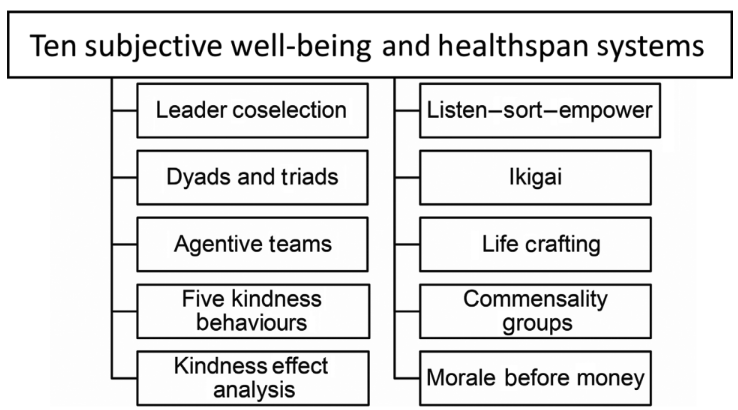
Steve deep dives into each of these. Below are some practices that I have experienced or conditions I’ve strived to create:
- Promoting Agency by asking the team how to improve, prioritizing where to focus and empowering the team to execute on the opportunities.
- Ikigai and lifecrafting: Creating space and giving opportunities for people work on personally meaningful work.
- Having lunch or coffee as a team :)
- Pushing the decisions of work-life balance down to the people that actually have to live with the choices. Colleagues are adults and providing them with agency in these matters creates psychological safety.
Five kindness behaviours: Leader behaviours that reduce emotional exhaustion and engender satisfaction.
- Seek to understand
- Solicit input from colleagues with humility
- Appreciate
- Recognise associates with authentic gratitude
- Mentor
- Nurture and support coworker aspirations
- Foster belonging
- Welcome everyone with respect and
acceptance- Be transparent
- Communicate openly for collective decisions
Other references to Steve’s work:
The Mayo Clinic model of care.
Framework to Reduce Professional Burnout - [PDF] via linkedin.
Image: The Harbinger of Autumn (1922) by Paul Klee.
Jan 10, 2025 - AI Agents, Machiavelli's Study
January 10, 2025
Agents Are Not Enough #
Last year I was heavily experimenting with Knowledge Graphs because it’s been clear that LLMs by themselves fall short because of the lack of knowledge. This paper by Chirag Shah and Ryen White (you can click the heading above) from Dec 2024 expands on those shortcomings by exploring not just knowledge but also value generation, personalization, and trust.
They open the paper by casting a very wide definition of an “agent” everything from thermostats to LLM tools. While this seems facetious at first, their next point is interesting. Agents by definition “remove agency from a user in order to do things on the user’s behalf and save them time and effort.”. I think this is an interesting way to injext an LLM flavored principal agent problem into the Agentic AI conversation.
Their broad suggestion is to expand the ecosystem of agents by including “Sims”. Sims are simulations of the user which address
- privacy and security
- automated interactions and
- representing the interests of the user by holding intimate knowledge about the user
It’s a short easy read, if you have 10 min.
Machiavelli and the Emergence of the Private Study #
Infinite knowledge is available through the internet today. It is available trivially and, some, ahem, blogs make a performance of consuming it. Machiavelli used to
put on the garments of court and palace. Fitted out appropriately, I step inside the venerable courts of the ancients, where, solicitously received by them, I nourish myself on that food that alone is mine and for which I was born, where I am unashamed to converse with them and to question them about the motives for their actions, and they, in their humanity, answer me. And for four hours at a time I feel no boredom, I forget all my troubles, I do not dread poverty, and I am not terrified by death. I absorb myself into them completely.
Some folks have a private office, but an office is not a study. A study or, studiolo
in Italian, a precursor to the modern-day study — came to offer readers access to a different kind of chamber, a personal hideaway in which to converse with the dead. Cocooned within four walls, the studiolo was an aperture through which one could cultivate the self. After all, to know the world, one must begin with knowing the self, as ancient philosophy instructs. In order to know the self, one ought to study other selves too, preferably their ideas as recorded in texts. And since interior spaces shape the inward soul, the studiolo became a sanctuary and a microcosm. The study thus mediates the world, the word, and the self.
In the 1500s Michel de Montaigne writes:
We should have wife, children, goods, and above all health, if we can; but we must not bind ourselves to them so strongly that our happiness [tout de heur] depends on them. We must reserve a back room [une arriereboutique] all our own, entirely free, in which to establish our real liberty and our principal retreat and solitude.
A little later, Virginia Woolf points out what seems to be an eternal inequality by struggling to find “a room of one’s own”.
The enclosure of the study, for those of us lucky to have one, offers us a paradoxical sort of freedom. Conceptually, the studiolo is a pharmakon, a cure or poison for the soul. In its highest aspirations, the studiolo, as developed by humanists from Petrarch to Machiavelli to Montaigne, is a sanctuary for self-cultivation. Bookishness was elevated into a saintly virtue
The world today would perhaps be better off if more of us had our own studiolos.