The Cosmos and the Model
Humboldt, the Romantics, and What AI Loses by Averaging
I. The Averaging Machine #
In 2025, researchers at USC ran a study that produced a result nobody expected. Atari et al., “AI-Powered Homogenization of Scientific Reasoning,” Trends in Cognitive Sciences (2026). They gave people reasoning tasks, some with LLM assistance, some without. Individual performance improved. Every metric showed it: more accurate responses, faster completion, fewer errors. The LLM made each person better.
Then they looked at the groups.
When individuals used LLMs, their collective reasoning got worse. Not because any one person performed badly, but because the range of approaches collapsed. Everyone converged on similar solution paths. The statistical minority who would have tried something lateral, weird, or wrong-in-an-interesting-way got pulled toward the model’s center of gravity. The group lost the variance that makes collective intelligence work.
This is a strange kind of failure. Not the dramatic kind — no hallucinated facts, no rogue agents. The quiet kind: a system that makes every individual more capable while making the species less intelligent. The modernity machine The Modernity Machine: Venkatesh Rao’s framework for the ~400-year civilizational configuration built on convergence, legibility, and compression. See “The Architecture of Resistance” for a fuller treatment. spent four centuries compressing physical labor into legible units. The LLM is completing the project by compressing thought itself.
The crabs have come for cognition. “Carcinization” — the evolutionary tendency toward crab-form — as metaphor for how selective pressure toward legibility produces identical exoskeletons. See “The Octotypic Mind.”
II. The Counter-Enlightenment Saw This Coming #
In 1751, Denis Diderot published the first volume of the Encyclopedie. Seventeen volumes of text, eleven volumes of plates. The project’s premise was breathtaking in its confidence: all human knowledge could be organized into a single rational system, cross-referenced, made available to any educated reader. One set of truths. One standard of reason. Universally accessible because universally correct. Difference was temporary. Education would fix it.
The counter-Enlightenment was the two-century argument against this premise.
Johann Gottfried Herder argued in the 1770s that each culture embodies its own irreducible form of human excellence — not a stage on the way to universal reason but a complete and incommensurable way of being human. You cannot rank these cultures on a single scale because they are not trying to do the same thing. The Inuit relationship to ice, the Balinese relationship to social hierarchy, the German relationship to music — these are not approximations of some Platonic human culture. They are the culture. Full stop. Isaiah Berlin spent his career rehabilitating this tradition. See Against the Current (1979) for the definitive modern treatment of Herder, Vico, and Hamann.
Giambattista Vico made the epistemological case: you can only understand a civilization from the inside, through what he called fantasia — imaginative participation in its forms of life. External analysis, however rigorous, misses the thing that matters. You can catalog every grammatical rule of a dead language and still have no idea what it felt like to be scolded by your mom in it.
Impose a single standard of reason, and you will not elevate humanity. You will flatten it. You will produce people who can all pass the same test while losing the capacity to produce the test’s questions.
Now hand the encyclopedistes a GPU cluster and let them train a model on the output of one civilization’s dominant voices. Deploy it globally as a reasoning assistant. Watch the assumption-grounds converge. An “assumption-ground” is the web of taken-for-granted beliefs against which new ideas register as interesting, obvious, or absurd. When LLMs homogenize these grounds across populations, the same ideas become obvious to everyone and the same ideas become absurd to everyone. The zone of the interesting — the productive middle — narrows. The counter-Enlightenment’s nightmare, arriving two and a half centuries late, wearing the mask of a helpful chatbot.
III. The Jena Experiment #
Between 1795 and 1800, a group of writers and philosophers in the German university town of Jena attempted something unusual. They tried to build a knowledge-production system that ran on disagreement.
The core members — Friedrich Schlegel, his brother August Wilhelm, Novalis, Schelling, and a handful of others — called their practice symphilosophie: co-philosophizing. They published the Athenaeum journal, whose 451 aphorisms were written by different authors and printed without attribution. The form itself was the argument: thought is irreducibly collective, and the best ideas emerge not from individual genius but from distinct minds in productive collision.
The collision was real. Fichte believed the transcendental Ich was the absolute first principle of philosophy. Schelling argued that nature itself generates consciousness — mind emerges from matter, not the other way. Schlegel rejected the entire premise: “No system can be absolute. One can only become a philosopher, not be one.” These were not different emphases. They were incompatible positions held in creative tension by people who knew each other well enough to argue honestly.
Caroline Schlegel — later Schlegel-Schelling — was described by scholars as the intellectual center of the group, “the conductor of the great symphony.” The meetings, the translations, the letters that constitute early Romanticism’s primary documentation all flowed through her.
Novalis, the poet-philosopher who died at twenty-eight, theorized the practice: “Every person who consists of persons is a person to a higher power, a person squared.”
What made it work was not agreement or even mutual respect in the usual sense. It was that each member maintained an irreducibly distinct position — a cognitive terroir that could not be averaged into anyone else’s. The symphilosophie was generative precisely because Schlegel’s ironic anti-systematism could not be reconciled with Schelling’s nature-philosophy. The disagreement was the engine.
And then it collapsed.
Novalis died of tuberculosis in 1801. Auguste Bohmer — Caroline’s only surviving child — died in 1800, a loss that cracked the social fabric of the circle from within. Personal relationships fractured along the lines of grief. Friedrich Schlegel, the arch-ironist who had declared that no system can be absolute, converted to Catholicism and became a political conservative. The man who invented the fragment as a form of anti-totality spent his later years writing theology.
The Athenaeum lasted three years.
The Jena experiment proves two things simultaneously. First: cognitive diversity, maintained in intimate productive tension, generates knowledge that no individual thinker can achieve alone. This is the empirical point behind the USC finding. The Jena circle is the historical case study; the USC data is the contemporary confirmation. Cognitive diversity is a group resource that individual optimization destroys. Second: the conditions for this kind of production are fragile. They depend on trust, intimacy, and a shared tolerance for irresolution that cannot be institutionalized and does not scale. When the intimacy broke, the diversity collapsed — not into synthesis, but into dogmatism and silence.
If symphilosophie is a divergence machine, it is one that runs on fuel it also consumes.
IV. Humboldt’s Escape #
Alexander von Humboldt was adjacent to the Jena circle — close to Goethe and Schiller, familiar with Schelling’s nature-philosophy, admired by Schlegel — but never quite inside it. This turned out to be his advantage.
Where the Romantics built their knowledge system on intimate collision, Humboldt built his on correspondence. Over his lifetime, he wrote approximately fifty thousand letters to scientists, explorers, indigenous knowledge-holders, and government officials across the world. His network was not a salon but a web — mutual respect across distance, sustained by shared curiosity rather than shared rooms.
His masterwork, Cosmos (1845-1858), attempted what no one had attempted before: a comprehensive description of the physical universe. But the method was what mattered. Humboldt did not compress knowledge into a single explanatory framework. He composed it.
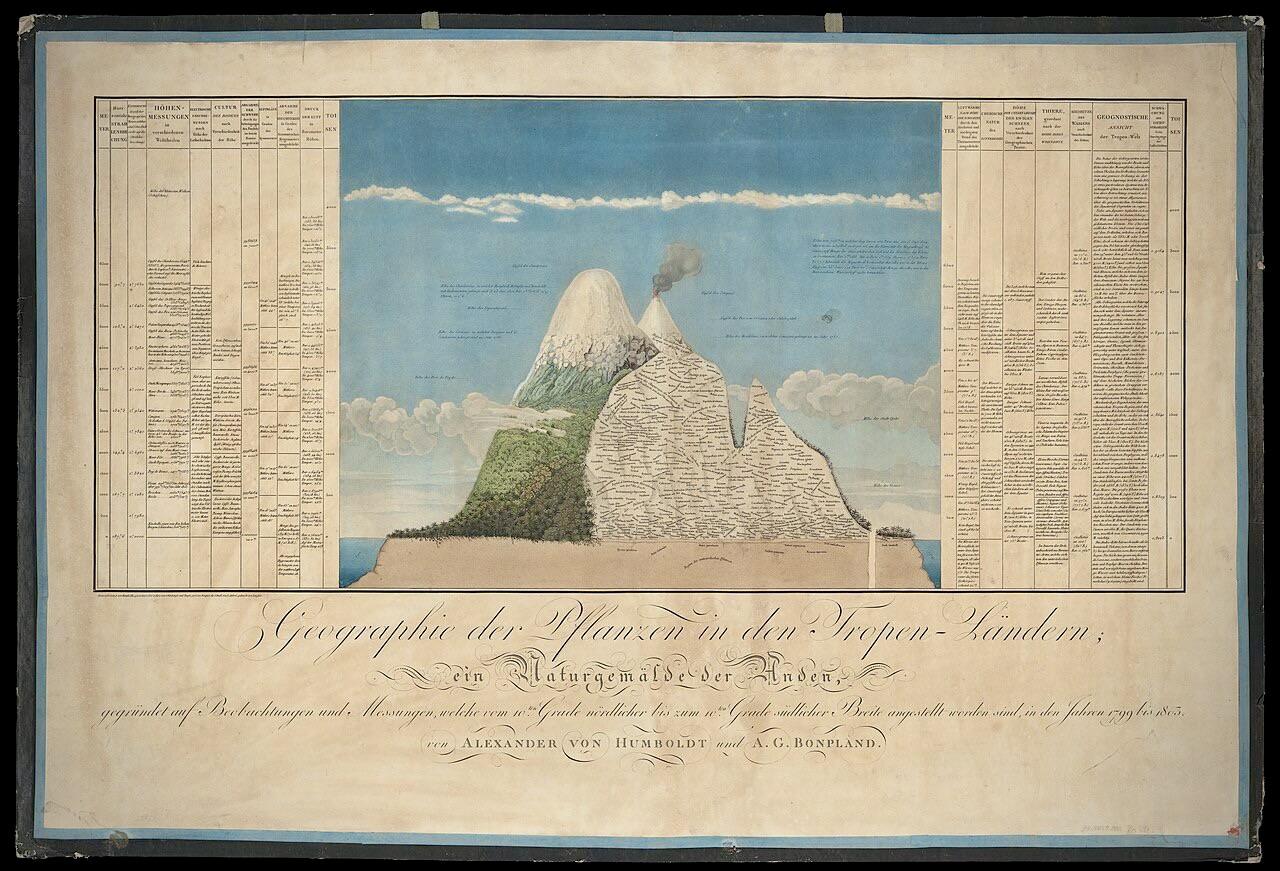
Look at his Naturgemalde — the “nature-painting” — of Mount Chimborazo. It is an enormous sheet of paper, and all of nature is on it at once. The mountain rises in cross-section at the center. Along its slopes, plant species are labeled at their precise elevations. In columns flanking the mountain, Humboldt has listed everything else he measured at each altitude: temperature, humidity, atmospheric pressure, the blueness of the sky, the boiling point of water. Geology runs down one side. Botany runs up the other. Nothing is averaged. Nothing is reduced. You stand in front of it and your eye moves between domains — from the mosses at the snowline to the barometric pressure at the same height — and the connections appear not because someone has explained them but because the data has been composed so that you can see them yourself. In the vocabulary of spatial epistemology: the Naturgemalde is epistemic place-making. It creates an inhabitable view of knowledge. An LLM embedding space, by contrast, is epistemic space — undifferentiated, navigable only by the model itself. See “The Shelter as Epistemic Engine.”
This is synthesis by composition. The opposite of synthesis by compression.
Humboldt insisted that aesthetic experience had cognitive value — that “what speaks to the soul escapes our measurements.” He studied trees not as isolated specimens but “in relation to one another, seeing them as members of a forest.” He criticized the fragmentation of knowledge into disciplines and argued that “the history of science cannot be divorced from the history of art.”
And he learned from everyone. In South America, Humboldt drew extensively on indigenous botanical classification systems and ecological knowledge. His famous observation at Lake Valencia — that deforestation was changing the local climate — came from combining European measurement techniques with indigenous ecological understanding that no European naturalist possessed. His cosmopolitanism was not abstract tolerance. It was method. He was better at science because he refused to limit his sources to one civilization’s way of knowing. Andrea Wulf’s The Invention of Nature (2015) and Magnificent Rebels (2022) are the best popular treatments of Humboldt’s method and his relationship to the Jena circle.
Humboldt survived where the Jena circle didn’t because his model scaled. Correspondence does not require intimacy. It requires something lighter and more durable: the willingness to take seriously what arrives from a mind organized differently from your own. In Rao’s divergence framework, this is a survival mode — maintaining productive relation with other nodes without requiring convergence or proximity. The divergence machine’s fundamental problem: how do distinct agents stay in productive contact without either converging (homogenization) or fragmenting (balkanization)? Humboldt’s answer: correspondence networks. Mutual respect across distance.
V. Two Escapes from the Smoothening #
The LLM’s default behavior is to smooth. Trained on the statistical center of its corpus, optimized for helpfulness as defined by its annotators, it produces outputs that converge on the most probable response. A 2026 study in Nature documented this in scientific writing: AI-mediated prose is flattening terminology, narrowing discourse, and creating what the authors call “informational conformity.“ “AI is turning research into a scientific monoculture,” Nature Communications Psychology (2026). The modernity machine carcinized labor. The LLM carcinizes language, and with it, thought.
Two architectures of escape suggest themselves. Neither is sufficient alone.
The Herderian Escape: Structural Pluralism #
Build many models. Not “multilingual GPT” — one model wearing many language masks — but genuinely different systems rooted in different epistemic traditions. Models trained within specific linguistic-cultural corpora. Different architectures reflecting different commitments about what reasoning is. Evaluation metrics beyond “helpfulness” as defined by WEIRD annotators.
The Herderian escape takes seriously that there may be no single correct way to model thought. A Yoruba-reasoning system and a Japanese-reasoning system might share no common optimization target, and that would be a feature, not a bug. The user would choose which tradition to consult — or consult several and hold the tension themselves.
The failure mode is balkanization. Each model becomes a silo. Translation between them is lossy and nobody bridges the gap. This is the Jena disintegration at scale: diversity without productive contact collapses into mere separation. Herder himself was a pacifist pluralist, but the political inheritors of his ideas built nationalism. The gap between “each culture is incommensurable” and “our culture is supreme” turns out to be tragically small.
The Humboldtian Escape: Compositional Architecture #
Build one system that maintains internal diversity. Modular representations that compose rather than compress. Domain-specific “observers” that maintain their own representation spaces, with a composition layer that reveals relationships without flattening them into a single embedding. Yann LeCun’s JEPA (Joint Embedding Predictive Architecture) is structurally Humboldtian. It predicts in representation space, not pixel/token space, maintaining domain-specific encoders while learning a predictor that maps between them — revealing connections without collapsing domains. LeCun explicitly frames JEPA as discarding noise while preserving abstract structure, the opposite of generative models that reconstruct everything. The limitation: current implementations use a shared latent space within a modality. True Humboldtian AI would need multiple domain-specific spaces with cross-domain prediction — closer to LeCun’s 2022 “world model” vision, not yet realized.
Retrieval-augmented approaches that preserve source material in its original form rather than digesting it into parameters. Outputs that show their composition — here’s the botanical view, here’s the geological view, here’s where they connect — rather than a single averaged answer.
The failure mode is that the synthesizer becomes the new hegemon. Whoever designs the composition layer decides what “connection” means, which domains get represented, and how conflicts are resolved. Humboldt could hold the tensions because he was Alexander von Humboldt. An algorithm that claims to compose fairly is just a more sophisticated form of the averaging it claims to escape.
The Tension #
The Herderian and Humboldtian escapes correspond roughly to two intuitions about diversity: that it requires separation (different traditions, different systems, hard boundaries) or that it requires integration (one system, modular internals, connections without collapse). The honest answer is that we do not know which is correct, and the history suggests both are partly right and partly dangerous. Herder leads to nationalism if you’re not careful. Humboldt leads to cosmopolitan hegemony if you’re not careful. The productive move is to hold them in tension rather than resolving them — which is, of course, exactly what the Jena circle would have recommended.
VI. The Terroir of the Mind #
But here’s what neither architecture solves on its own.
A Herderian system that presents five cultural perspectives is richer than a monocultural LLM. A Humboldtian system that composes domain-specific views is more honest than one that averages them. Both are improvements. Neither guarantees that the person using them will do anything with the diversity on offer.
This is not a user-blaming argument. It is a design argument.
The octopus shed its shell not because it was told to self-actualize but because its environment rewarded a different body plan. The rangaku scholars of Tokugawa Japan were de-carcinized not by willpower but by the absence of institutional fences. The conditions came first. The organism responded.
The question is what conditions current AI creates for the mind that uses it.
The default condition is smoothening. You ask a question, you get the most probable answer, you move on. Over thousands of interactions, your assumption-ground — the web of things you take for granted — drifts toward the model’s center of gravity. Not because you’re weak or passive, but because the tool’s design makes convergence frictionless and divergence effortful. The explorer who wants to push into unfamiliar territory has to actively resist the model’s pull toward the known. The tourist who accepts what’s offered gets carried downstream.
But the alternative condition is the most powerful terroir-cultivation tool ever built. And it already exists, in embryo, inside the current one.
Consider what happens when you use an LLM not as an oracle but as a sparring partner. You bring a half-formed idea — say, a suspicion that eighteenth-century German Romantics anticipated something about AI — and the model pushes back. It channels Herder in one breath and LeCun in the next. It tells you that your analogy is structurally strong here and historically careless there. It surfaces a Novalis quote you hadn’t read and a 2026 paper that contradicts your premise. You argue. You revise. You find yourself defending a position you didn’t know you held until the model forced you to articulate it against resistance.
This is symphilosophie. Not the full Jena version — nobody is dying of tuberculosis or stealing anyone’s spouse — but the epistemic core: distinct positions held in productive collision, generating knowledge that neither party could produce alone. The Jena circle needed a salon, shared meals, years of intimacy. The prototype is already running in a terminal window. The difference is that the model can channel any tradition, not just the ones that happened to show up in Jena in 1798. Humboldt needed fifty thousand letters and a lifetime of travel to build his web of diverse correspondents. You need a prompt.
The catch — and it is a real catch — is that this only works when the model preserves the tensions rather than resolving them. An LLM that says “here are three ways to think about this, and they conflict” is cultivating your terroir. An LLM that smooths those three ways into a seamless synthesis is eroding it. The difference is not in the model’s capability but in its defaults. Current defaults favor the synthesis. They favor coherence, helpfulness, the single best answer. They are, in effect, trained to resolve the productive disagreements that the Jena circle spent three years carefully maintaining.
Novalis had a formulation for what the better default would produce. After abstraction, he wrote, everything is unified again — “but this unification is a free interconnection of independent, self-determined beings.” The emphasis is on self-determined. The interconnection works only if the nodes maintain their own shape. A model that does the determining for you — that resolves every tension into a single answer — is not interconnection. It is absorption. A model that presents the tensions and lets you navigate them is something else: a Naturgemalde of ideas, composed for an observer who brings their own eyes.
The fox in the dark forest knows this intuitively. In “How the Fox with the Long Tail Learned to Play in the Dark Forest,” fascination is what keeps the dilettante alive in the thicket — the delight that precedes and survives any professional identity. In “The Octotypic Mind,” it becomes the beak: the minimum viable rigidity of the otherwise boneless octopus, the one hard part it cannot dissolve without ceasing to be itself. Fascination — the beak, the irreducible core that survives every molt — is what keeps the mind’s terroir distinct. You cannot homogenize someone’s fascinations. You can only fail to feed them. And a well-designed AI is the richest feeding ground fascination has ever had: every tradition accessible, every disagreement surfaceable, every weird lateral connection one prompt away. The rangaku scholars had one pinhole to the outside world — the Dutch trading post on Dejima. We have all of them, simultaneously, if the tool doesn’t smooth them into one.
The problem is not that people need to be told to cultivate themselves. The problem is that the default tool actively works against the cultivation that would otherwise happen naturally. Fix the defaults — surface diversity, preserve tension, reward the explorer’s impulse to push further rather than the tourist’s impulse to accept the first answer — and the terroir takes care of itself. Not because humans are naturally deep thinkers, but because humans are naturally curious, and curiosity, left unfenced, produces exactly the kind of irreducible particularity that makes collective intelligence work.
VII. The Cosmos and the Model #
Humboldt was that kind of node — a self-determined being in a network of self-determined beings. He stood on the slopes of Chimborazo in 1802 and saw the whole world at once. Not a flattened world — not a world reduced to a single measurement or a single theory — but a composed world: vegetation zones layered against altitude, altitude against atmospheric pressure, pressure against temperature, all of it held together by the observer’s willingness to see connections without demanding that everything reduce to one.
He painted this. The Naturgemalde is a portrait of knowledge that refuses to average.
What made the portrait possible was not genius in the Romantic sense — not the solitary visionary channeling the infinite. It was the network. Fifty thousand letters. Indigenous botanists in the Orinoco basin. Parisian mathematicians. Goethe’s gentle empiricism. Schelling’s speculative nature-philosophy. Each correspondent maintained their own terroir — their own way of knowing, their own fascinations, their own beak — and Humboldt’s gift was composing their contributions without compressing them. The Naturgemalde is what a knowledge system looks like when its architect believes that every domain speaks in its own voice and the connections emerge from juxtaposition, not reduction.
Two centuries later, we are building systems that also attempt to hold all knowledge at once. They are trained on more data than Humboldt could have imagined. They process faster, cover more ground, make fewer arithmetic errors. But they achieve their synthesis by compression — by passing everything through a single statistical lens that produces the most probable output.
Humboldt’s cosmos is a place. You can stand in it, look around, notice things the painter didn’t intend you to see. The model’s output is a destination — you arrive, you receive, you leave. The difference is not capability. It is architecture. One was designed to preserve the particular. The other was designed to predict the average.
The Jena Romantics understood, briefly and brilliantly, that knowledge produced in collision is richer than knowledge produced in consensus. Their experiment failed because the conditions for productive collision — trust, intimacy, tolerance for irresolution — are fragile and consume themselves. Humboldt built a more durable version: a web of correspondence where distinct minds maintained their distinctness while feeding each other’s work. Neither model maps perfectly onto the AI question. But together, they frame it.
We are not choosing between AI and no-AI. We are choosing between compression and composition. Between a model that smooths the world into a single surface and one that composes it from multiple, irreducible vantage points. Between carcinization of thought and the cultivation of terroir.
The Romantics would remind us that this choice has been made before, and that the universalists won the first round. The counter-Enlightenment’s objections were correct — imposing a single standard of reason on all cultures did destroy irreplaceable particularity — but they lost the political argument. Monism was too useful. Legibility was too efficient. The modernity machine ran on convergence and it ran for four hundred years.
The question is whether the next four hundred years run on the same fuel — or whether we build networks that produce more Humboldts. Not through exhortation. Through architecture. Through tools that reward the curious mind’s natural impulse to wander across boundaries, collect strange specimens, and compose them into something no one else would have thought to paint.
Novalis, dying at twenty-eight, left behind eleven hundred notebook entries for a Romantic encyclopedia he would never finish — an atlas of knowledge that used “the magic wand of analogy” to connect disciplines without collapsing them. His vision: not one system explaining everything, but many systems in free interconnection, each self-determined, each irreducible, each enriched by contact with the others.
We have the tools to build his encyclopedia now. We just keep building the Encyclopedie instead.
Join the conversation moderated
No comments yet — start the conversation.
Replying to
Thanks — your comment is awaiting moderation.