The Lightening of Intent
Why Execution Got Cheap and Intent Got Live
I. Ceolfrith on the road #
In late spring 716, an English abbot named Ceolfrith left the twin monastery of Wearmouth-Jarrow in Northumbria for the city of Rome. He was seventy-four. He carried with him a manuscript Bible, the Codex Amiatinus, which he intended to present as a gift to Pope Gregory II. The Codex contained the entire Latin Bible in two volumes, weighed about seventy-five pounds, and required something close to one thousand calfskins to produce. Ceolfrith had commissioned three of these “pandects” at his abbey; this was the survivor he meant to deliver in person. The other two pandects are lost. The Codex Amiatinus was misattributed to a sixth-century Italian scribe for more than a thousand years; only in 1888 did Giovanni Battista de Rossi establish that the dedication page had been altered and the manuscript was Northumbrian work. He died at Langres in eastern Burgundy on 25 September 716, six months into the journey, before reaching Rome. His companions carried the Codex on. It sits today in the Biblioteca Medicea Laurenziana in Florence and is the oldest complete Latin Bible in the world.
What it cost an early-medieval civilisation to put a single book on the road to Rome: a flock of cattle, several years of scribal labour, the grain to feed sixty monks for the duration, and the life of one of its most accomplished men. Eight centuries later a person publishes an essay on a laptop, pays nothing, and reaches more readers in an afternoon than the Codex has been read in thirteen hundred years.
Between these two scenes the cost of putting an idea into the world has fallen by roughly five orders of magnitude. The bottlenecks have reversed: putting atoms in a particular order used to be the bottleneck, now having ideas is. Soon, it will be intents, but I’m getting ahead of myself.

II. A millennium of falling cost #
In the fifth century BCE about eighty percent of any civilisation’s population worked the land. Classical Athens had perhaps two hundred and fifty thousand people; only a fraction of male citizens could live an intellectual life. For every philosopher or playwright twenty to forty people grew food. Those who did think for a living required a school, a patron, a tradition that itself ran on generations of accumulated agricultural surplus. The Lyceum was subsidised by an entire civilisation’s caloric output. Aristotle’s school in Athens, founded around 335 BCE on the grounds of a temple to Apollo Lyceus. Students and master walked the colonnades while they argued; the building was the school’s caloric infrastructure, the city was the school’s caloric infrastructure’s infrastructure.
The medieval centuries improved the ratio but not the order of magnitude. By the twelfth century monasteries and the early universities had built institutional capacity for sustained intellectual work. A Bible cost a craftsman’s annual income. Across all of Europe before 1450 fewer than five million manuscripts existed and five percent of the population received any formal education. The whole apparatus rode on agriculture whose total energy return was barely 1.6 calories out for every calorie invested.
The printing press changed the rate of change. Gutenberg produced a hundred and eighty Bibles in the time a scriptorium managed one. Book prices fell 2.4 percent per year for over a century. Each new printer in a city dropped prices by another quarter. Pre-print Europe contained fewer than five million manuscripts; the sixteenth century produced two hundred million printed books, the eighteenth a billion. The doubling time for European book production collapsed from roughly 104 years before 1450 to 43 years after. Gutenberg accelerated the rate of change.
The cascade did not stop with print. The penny press of 1833 put newspapers at one cent where a subscription had cost more than a skilled worker’s weekly wage. The mass press of the early twentieth century carried single editorial decisions to populations of millions in a morning. By 2010 a person with a laptop and an internet connection reached a global audience for the cost of the connection.
Then AI. By 2026 a single query no longer just reaches a thousand minds. It coordinates a thousand minds’ worth of cognitive labour in a few seconds, performed by a model trained on the accumulated text of human civilisation. The marginal cost of execution has fallen below the noise floor of measurement.
The production cost of an idea worth executing has not fallen with it. Formulating a direction, choosing what to commit to, sitting with confusion long enough for clarity to emerge: these still take a human brain, time, and attention. The Cistercian monk who had an idea but no scriptorium was stuck. A person today who has the scriptorium but no idea is stuck in the opposite direction.
III. The system burns hotter #
There is a single quantity that tracks complexity across every known system in the universe: the rate at which free energy flows through it, per unit mass. Measured in ergs per second per gram, it rises monotonically from the simplest structures to the most complex. Galaxies sit at about half an erg per second per gram. Stars at two. Planets at seventy-five. Plants at nine hundred. Animals at twenty thousand. The human brain at a hundred and fifty thousand. Modern human society, in aggregate, gram for gram, sits above five hundred thousand. It is the most energy-dense phenomenon known. That is, until very recently, AI will soon push this higher.
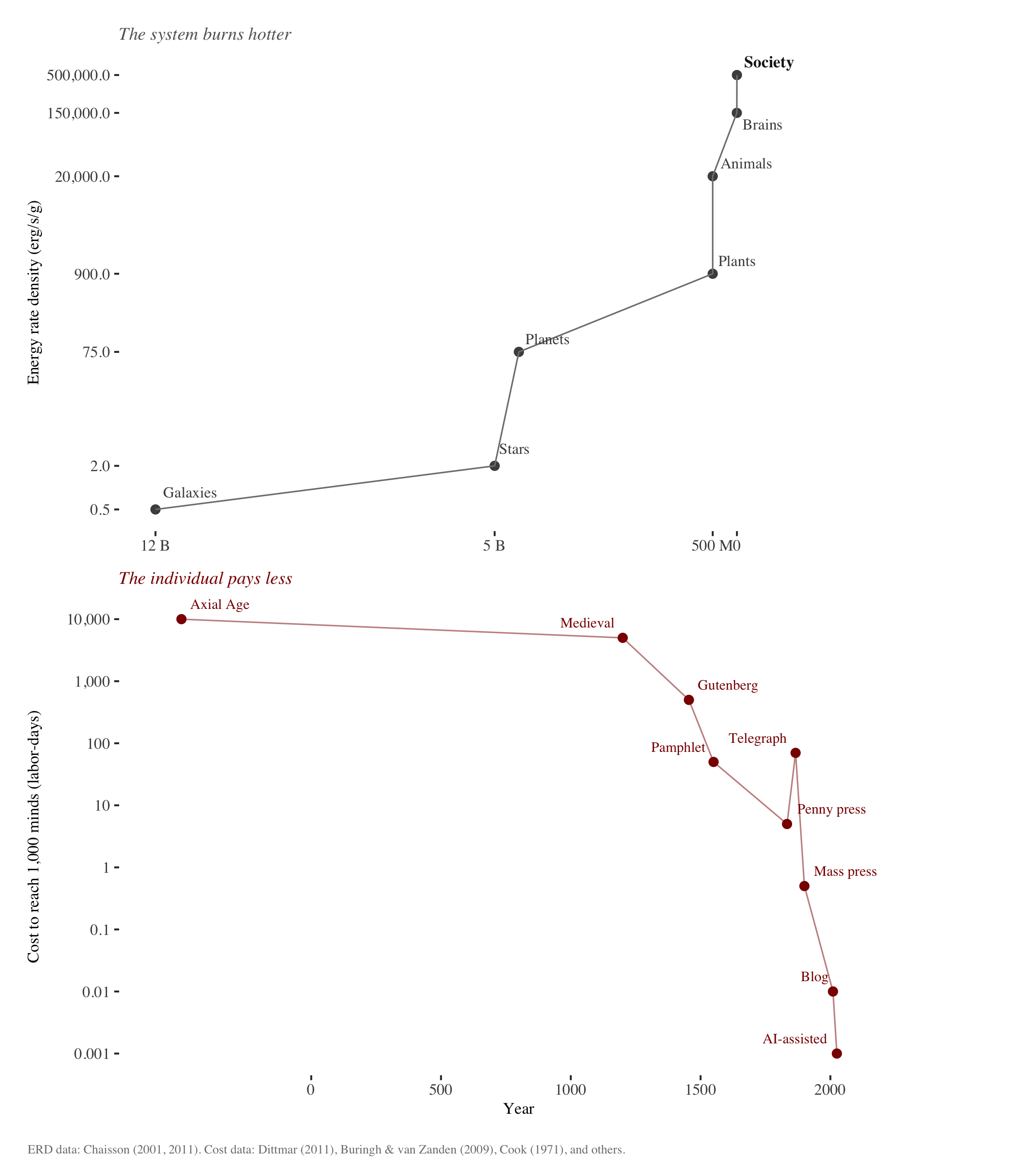
This is the curve that intention rides. Per-capita energy consumption has risen from about two thousand kilocalories a day in the palaeolithic, all of it food, to two hundred and thirty thousand in the modern United States. Each step up (fire, agriculture, animal traction, water and wind, fossil fuels) created surplus, and the surplus built infrastructure. Roads, aqueducts, postal routes, universities, telegraph lines, fibre optic cables, data centres. The infrastructure converts raw civilisational energy throughput into something an individual can ride. Your intention does not power the servers; a century of accumulated infrastructure does.
The infrastructure also amplifies superlinearly. Double a city’s population and you get more than double its innovative output but less than double its infrastructure demand. The system becomes a better amplifier of individual action the larger it gets.
This explains the sharp acceleration of the cost curve in the last four centuries. The civilisational operating system that ran from roughly 1600 to 2000, the Modernity Machine, built its infrastructure to serve a single canonical direction. The press was deployed for Bibles and law codes before pamphlets. The telegraph served governments and banks before anyone else. Railways moved coal and troops before passengers. Four centuries of convergent effort produced an enormous apparatus aimed at Progress.
Infrastructure, once built, is agnostic about what flows through it. The cables do not care whether they carry imperial dispatches or revolutionary tracts. When the canonical direction exhausted itself, what remained was the apparatus, intact and humming, available for any purpose. The Divergence Machine inherited it and reversed the polarity. The same networks built for convergent ends now amplify divergent ones.
AI continues the climb. Training and serving a frontier model consumes more energy than the annual electricity demand of a small city. The world is investing in the path anyway. The system keeps burning hotter, and a larger fraction of that burn is now going into individual liveness rather than industrial production.
IV. Atoms downstream #
The abbot dude acted on ideas, but to execute them he had to move atoms. Animal skins, ink, stone, timber, food. The ratio of matter moved to idea propagated was staggering.
Cosimo de’ Medici, three centuries later, faced the same constraint at greater scale. He spent something like six hundred thousand gold florins on intellectual patronage, more than thirty years of his bank’s peak annual profits. His project was ideational, cultivate philosophy and art and humanism, but the execution was almost entirely material: converting banking profits into buildings and salaries. The conversion rate from intention to cultural influence was ruinous.
The direction of causation between ideas and matter has reversed. The pamphlet of the Reformation rearranged the beliefs of thousands across Europe in a generation, and rearranged beliefs then rearranged what people bought, built, fought for, and abandoned. The idea did not move atoms directly; it moved minds, and the minds moved atoms more efficiently than any patron’s direct expenditure.
Today writing code that deploys to servers coordinating global supply chains is an act on ideas; the atoms rearrange themselves downstream. The HTTP standard, written as a specification in the early 1990s, has restructured several trillion dollars of physical economic activity over thirty years. Its authors wrote the specification in some weeks. The atoms moved themselves.
The execution costs were not eliminated but socialised, distributed across continents and decades, embedded in fabs and undersea cables and the labour of millions maintaining the infrastructure. A single ASML extreme-ultraviolet photolithography machine costs about 350 million dollars; a leading-edge TSMC fab around forty billion. The near-zero marginal cost of a blog post rests on a material substrate of staggering expense, just not expense borne by the publisher. The abbot knew what his Bible cost because the cost was local and contemporaneous. The modern essayist does not, because the cost has been amortised across the system. The inversion is real at the margin, even as the system-level cost remains enormous.
When the conversion ratio from thought to material reality was punishing, the wisdom ran ideas are cheap, execution is everything. Incidentally this was also what I used to tell myself in my wet-lab days, with automation and AI, that is likely to change very soon. The ratio has inverted. Execution is cheap; ideas worth executing are scarce. What gets cheaper in the regime now emerging is not the individual paying less. It is the intent that gets cheaper to act on.
V. The soup before the spark #
Information accumulates. The internet has been doing this for thirty years, more visibly than any prior substrate. By 2026 it holds something on the order of two hundred zettabytes, mostly text and image, mostly read by machines and ignored by humans. Roughly ninety percent of all data ever created has been generated in the last two years. The great majority is read by machines, not humans. Most is not used at all. None of it is alive.
The pre-life ocean held its own accumulation, of amino acids and nucleotides and clays, for hundreds of millions of years before anything used the accumulation. The chemistry was not the difference. The difference was that something started to act on the chemistry. Substrate alone is inert. Substrate plus an actor, created by the cell membrane enclosure, that traverses it is what makes the substrate go somewhere.
Information has the same character. Data without intent is a soup of records that accumulates and forgets. The Library of Alexandria, the manuscript collections of the medieval monasteries, the print archives of the nineteenth century, the internet of the early twenty-first: each was a deeper pool than the last. Each remained a pool until something acted on it.
What is happening with AI is not a fourth pool. It is the first time the substrate has been wired to a borrowed spark. A large language model trained on the accumulated text of human civilisation does nothing until it receives a prompt. The prompt is a fragment of human intent transduced into a substrate that can now traverse the accumulation and produce something on the other side. The intent comes from a person; the model carries it across the substrate; the result is something the person could not have produced alone in any reasonable time, and could not have produced at all without the accumulated text. This is the substrate borrowing the spark of intent.
The behaviour of such a system resembles what living systems do. It traverses an environment. It produces outputs in response to inputs. It modifies itself based on feedback. None of this is alive in the biological sense. All of it is alive in the structural sense. Call it proto-liveness, in the literal sense of almost.
The other thing happening, more slowly, is that the layers between intent and substrate keep thinning. Earlier eras channelled intent through canonical religion, then Progress, then institutional credentialing; each removal made mediated execution cheaper and self-direction harder. The Liveness era removes the last layer. Intent meets a responsive substrate directly, with no intermediate institution telling it which direction it should go. The substrate does not care about canonical direction. It will execute on whatever intent it receives. What you intend is what runs.
VI. Intents red in tooth and claw #
When intent meets a responsive substrate, intent itself becomes the live quantity. The model, the cloud, the labour of the engineers maintaining them have all been pre-paid, amortised, made functionally free at the point of use. What is left is intent.
This produces a new mode of work, sometimes called auteuring. An auteur has extreme control over a project driven primarily by their taste. A bench scientist in 2026 submits a query to a generative model and receives a thousand candidate molecules in twenty minutes; her job is no longer to generate, it is to pick. An essayist using a large language model produces ten variants of a paragraph in the time it once took to write one; the keep is the auteur’s. In every case the model executes, the auteur picks, and the product is the auteur’s taste rendered through capacity that could not exist without the substrate.
For now intents do not collide. The substrate has room for every intent to fill. Every essay finds its niche; every founder finds adjacent space to build into. An early arriver has the field.
This will not last. As more brains and more resources are wired to the substrate, intents will start to encounter each other. Two people who disagree about something will not stop at posting on a platform. The first will commission an AI agent to write the counter-book in the disputed thinker’s style: full length, with footnotes and an index, indistinguishable in production quality from a publisher’s, in five days. The second will deploy a different agent to write the refutation, also full length, also in five days, also indistinguishable. The intent to disagree no longer needs an audience. It produces artefacts, and the artefacts compete.
The internet of beefs was the manual prototype for this. Rao’s 2020 framing described a stable low-grade civil war waged across social media: fights that were not about resolving anything, beefs as the medium through which identity and tribal belonging got transacted, knights performing for mooks. AI agents industrialise the underlying logic and shift its shape. The performance is no longer what holds the system together; the products are. Disagreement becomes a production pipeline. The intent to oppose is no longer expressed by yelling at someone. It is expressed by writing the better book, faster, and putting it into the same machinery that already promotes the original.
This is what intents red in tooth and claw will look like. The substrate has finite capacity, the resources behind it are finite, and once intents begin to encounter each other the question of which one gets executed will not be settled by who shouts loudest. Whoever has the better model, the better taste, the better access to the substrate will settle it. On this wager, the first generation of intent-collisions is three to five years out. The shape of the era will be determined in that interval.
VII. If the flow holds #
The whole argument so far rides on an energy anomaly. Pre-industrial agriculture was a net source: about ten calories of food output per calorie of human labour, modest surplus, enough to free five to twenty-five percent of the population from the field. Modern agriculture is a net sink: 13.3 calories of fossil-fuel input per calorie of food consumed. The surplus that frees ninety-seven percent of the population from farming does not come from farming. It comes from ancient sunlight, banked underground over geological time and drawn down at rates millions of times faster than it accumulated.
The drawdown is decelerating. Measured at the point of useful energy (the energy that does work, not the seventy percent wasted as heat in combustion), fossil fuels return only about 3.5 calories per calorie invested. For road transport, 1.6 to 1. The estimated minimum for a complex society is about 5 to 1. By honest accounting, fossil fuels are already below it.
The counter-development is solar. Photovoltaic costs have fallen from a hundred and six dollars per watt in 1976 to under a tenth of a dollar today, a thirteen-hundred-fold decline in less than fifty years. Swanson’s law: solar PV cost per watt declines roughly twenty-three percent with every doubling of cumulative installed capacity. The mechanism is manufacturing scale and process learning, not new physics, which is why the curve has been unusually robust to interruption. Solar’s useful-stage energy return is now estimated at twenty-five to thirty to one, seven to nine times higher than fossil fuels. Unlike fossil fuels, which decline as easy deposits deplete, solar’s returns improve as manufacturing scales.
The structural difference matters more than the numbers. Fossil fuels are a stock: a finite deposit, centralised extraction, diminishing returns. Solar is a flow: effectively infinite, arriving daily, capturable at the point of use, subject to increasing returns. The transition from stocks to flows is not a fuel substitution. It is a change in the geometry of energy.
If the transition holds, the substrate inversion stabilises. The Liveness era inherits not just the Modernity Machine’s infrastructure but a re-powered version of it, sustained on incoming sunlight rather than deposited carbon. AI’s energy appetite, currently provoking nervous arithmetic, becomes a solved problem. The intent-driven economy emerging now matures into the next civilisational machine rather than petering out as a brief window between fossil-fuel decline and substrate collapse.
If the transition does not hold, the substrate degrades faster than the intent-driven economy can mature, and the lightening of intent ends as a brief anomaly. Both outcomes are within reach. Which one obtains will depend on the next decade of capital, policy, and physics.
The companion essay, “The Viscous Frontier”, takes up how to act in this regime, with attention as your bath and no canonical direction pulling.
Coda #
The world-machines framework, including the Modernity Machine, the Divergence Machine, and the suggestion of a Liveness era to follow, is Venkatesh Rao’s; the essay assumes familiarity with his Contraptions writing on the topic, in particular “AI in World Machine Theory”. The “Internet of Beefs” essay linked in section VI is the source of the prototype-for-AI-mediated-intent-conflict reading.
The energy rate density framework is Eric Chaisson’s. Urban scaling exponents are from Geoffrey West, Luis Bettencourt, and colleagues at the Santa Fe Institute. EROI thresholds and useful-stage corrections are from Charles Hall and Brockway et al. respectively. Historical energy data are from Vaclav Smil and Earl Cook. The manuscript economics draw on Buringh & van Zanden; the printing-press economics on Dittmar; the Medici figures on de Roover.
The accumulation-as-substrate thread (that putting something down changes the environment for everyone else, irreversibly) runs through Spinoza, Voltaire, and Hume in different registers and is the older intellectual genealogy behind section V’s claim about information as inert until acted upon.
The Codex Amiatinus is in the Biblioteca Medicea Laurenziana in Florence. Ceolfrith is buried at Langres.
Join the conversation moderated
No comments yet — start the conversation.
Replying to
Thanks — your comment is awaiting moderation.