The Octotypic Mind
Carcinization, Cognitive Prosthetics, and the Shape of Intelligence After AI
The Scholars of Dejima #
In the 1770s, a samurai, a physician, and a Confucian scholar gathered around a Dutch anatomy textbook none of them could properly read. They were attempting a translation of the Tabulae Anatomicae. Sugita Genpaku and his collaborators, the rangaku-sha, “Dutch studies scholars” of Tokugawa Japan. The shogunate had sealed the country for over a century. European knowledge trickled in through one pinhole: the Dutch trading post on Dejima, a fan-shaped artificial island in Nagasaki harbor.
The shape of the translators matters more than the heroism of the translation.
These men had no disciplinary identity. They were not anatomists who happened to know Dutch. They were samurai-bureaucrats who studied medicine as a sideline, physicians who dabbled in astronomy, Confucian moralists who found themselves unexpectedly gripped by the problem of the human liver. Their knowledge was promiscuous, much like the Natural Philosophers in the West. Sugita mixed anatomy with botany. His colleague Maeno Ryotaku moved between linguistics and cartography without apparent anxiety about the crossing. They did not respect the boundary between fields because those boundaries had not yet hardened around them.
The word for what they were NOT doing is carcinization.
Carcinization #
Biologists have a term for one of evolution’s strangest patterns. At least five separate lineages of crustacean have independently evolved into crabs. The flattened body, the tucked abdomen, the heavy carapace. Not because crab-form is optimal. Because certain environments exert such consistent selective pressure that wildly different organisms converge on the same armored shape. Biologists call this carcinization. The world makes crabs.
The modernity machine made crabs of us.
For four hundred years, the economic environment favored organisms with hard, legible exoskeletons (professional identities) and highly specific, predictable claws (specialized know-how). The system did not want fluid intelligence. It wanted identical armored workers who could reliably pull the levers of mass production. It needed us to become places where events occurred. So, we carcinized. We grew shells: titles, credentials, disciplinary boundaries. We developed claws: the narrow expertise that could be slotted into the mechanism.
Jean Baudrillard noticed what happened next. While early technology served us, we began picking technology and objects to show the world who we are. The crab does not merely have an exoskeleton. The crab decorates it. The LinkedIn profile. The curated bookshelf behind the Zoom camera. “What do you do?” as the first question at every dinner party, as though identity requires an exoskeleton to be legible at all.
And the exoskeletons were, and are, useful. People clung to them because the world was genuinely hostile and the armor was genuinely protective. You could push against it to move. You knew your shape.
The Rangaku Counter-Example #
The rangaku scholars were de-carcinized. Japan’s isolation meant there was no institutional structure to force specialization. No anatomy department to claim Sugita, no linguistics faculty to contain Maeno. Knowledge was a landscape they crossed freely because no one had fenced it yet.
The Kaitai Shinsho of 1774, Japan’s first modern anatomy text, was produced by amateurs in the deepest sense. The word comes from the Latin amare. To love. They loved the problem more than any discipline.
The Bayt al-Hikma in eighth-century Baghdad. Syriac Christians, Zoroastrians, Sabians, Arab Muslims translating Greek, Persian, Sanskrit, and Syriac into Arabic with no regard for what we would now call disciplinary lanes. Hunayn ibn Ishaq: simultaneously physician, translator, and philosopher. The movement generated a civilization’s worth of intellectual output precisely because its practitioners refused to carcinize. It’s possible that it wasn’t even an option due to the paucity of a literate population.
Either way, it collapsed because the Mongol Horde imposed carcinization from outside. Carcinization is a political imposition, an expression of power. Not really a natural endpoint.
The Mansabdar’s Dilemma #
De-carcinization has costs.
The Mughal mansabdari system is the clearest demonstration of a deliberate, institutional de-carcinization program. Mansabdars held rotating ranks combining military and civil functions, transferred between provinces, prevented from building hereditary claims to any territory or specialty. A mansabdar might govern Bengal one decade and command cavalry on the Deccan frontier the next. John F. Richards described its logic as controlled impermanence.
The Mughals got extraordinary administrative flexibility. They also got chronic coordination problems. Mansabdars who never stayed anywhere long enough to understand local conditions. Expertise always being interrupted, always being reset. The system worked when the center was strong, when Akbar’s court could serve as the coordinating intelligence. It fractured when the center weakened.
De-carcinization is a design problem, not just an ideal. Every de-carcinized civilization needed cognitive prosthetics — tools that could hold identity lightly enough to let it shift.
Spreadsheets, Taming Noise, and Harnessing Liveness #
The cognitive tool of the early modernity machine was the double-entry ledger. A rigid, static instrument that forced reality into a zero-sum, balanced state. If you are what the ledger dictates, your identity is fixed. Debit, credit, balance. You are your sum.
But reality expanded past the mold. The world generated too much noise, too much non-canonicity, too much variance. Statistics provided a mathematical handle. The electronic spreadsheet provided the interactive playground. Change one assumption, watch the whole model ripple. The self behind the numbers becomes provisional.
The spreadsheet was the first tool that taught us to rehearse possible selves.
More importantly, the spreadsheet introduced liveness: the phenomenological experience of a model that responds. This is plasticity in practice, in Catherine Malabou’s precise sense.
Not flexibility. Flexibility is pliability to external demands, a bending under pressure. Essentially flexibility is the acceptance of risk as a factor you have no control over.
Plasticity is something else. The independent giving and taking of form. Plasticity is taking control of risk as a factor you control.
AI is the next cognitive prosthetic. Not because it models risk better — though it does — but because it absorbs the crab-work entirely, freeing the organism to operate where liveness is highest. The output of an AI agent is still a function of your SKILL and MOTIVATION. But where you aim that output — which risks you take, which serendipities you court — that is the exercise in liveness. The shell becomes delegable. What remains is the question of what the organism does once it molts. link to Venkatesh Rao’s definition of liveness
The Shell Agent #
AI does not care about your carefully constructed Baudrillardian identity. Monad-like, it reflects your expertise through the muddy prompt files without the nuance, art, and taste of the organism that produced them.
We are building AI agents, personal agents specifically, that act as us in the economic system. In 2026, temporarily popular tools like OpenClaw agents wear the exoskeleton so the organism doesn’t have to. They execute the crab-work: the predictable output, the tireless responsiveness, the legible professional performance. The agent is the delegated shell.
The economy still demands crabs. The agent produces crab-shaped output because the system is not yet ready for anything else. But behind the shell, or rather without the shell, something is happening to the organism underneath.
Unfortunately for us we are entering this time as Byung-Chul Han’s achievement subject. The person who internalized every demand, dissolved every external constraint, and discovered that freedom without structure is exhaustion. People told they are responsible for their own futures. That they have the capacity to reach their dreams, to be anything they want to be. Only to burn out.
The standard response to the molt is to grow a new shell quickly. Pivot. Learn to prompt. Carcinization reasserting itself: the reflex to armor up, to become legible again. But the Han objection cuts deeper. Maybe the problem is not the particular shell but the absence of one. Maybe some organisms need exoskeletons.
Maybe we are crabs all the way down…..But we aren’t.
The achievement subject is a psychological shell imposed by the politics of today. We burn out because our natural mind rebels against this shell though we may not understand why.
What distinguishes the burnout subject from the octotypic mind (the word I have been circling) is not the absence of structure but the location of structure. The burnout subject, the hustle-bro dissolved external structure and internalized the crabby cogginess of the modernity machine. The octotypic mind dissolves external structure and discovers their inner liveness.
The Octopus, or: A Confederation of Minds #
Time to look at the animal.
The octopus does not use a shell because having a shell is sacrificing control over risk. A shell, a soup can, or skull might be temporarily adopted but only until the imminent danger passes.
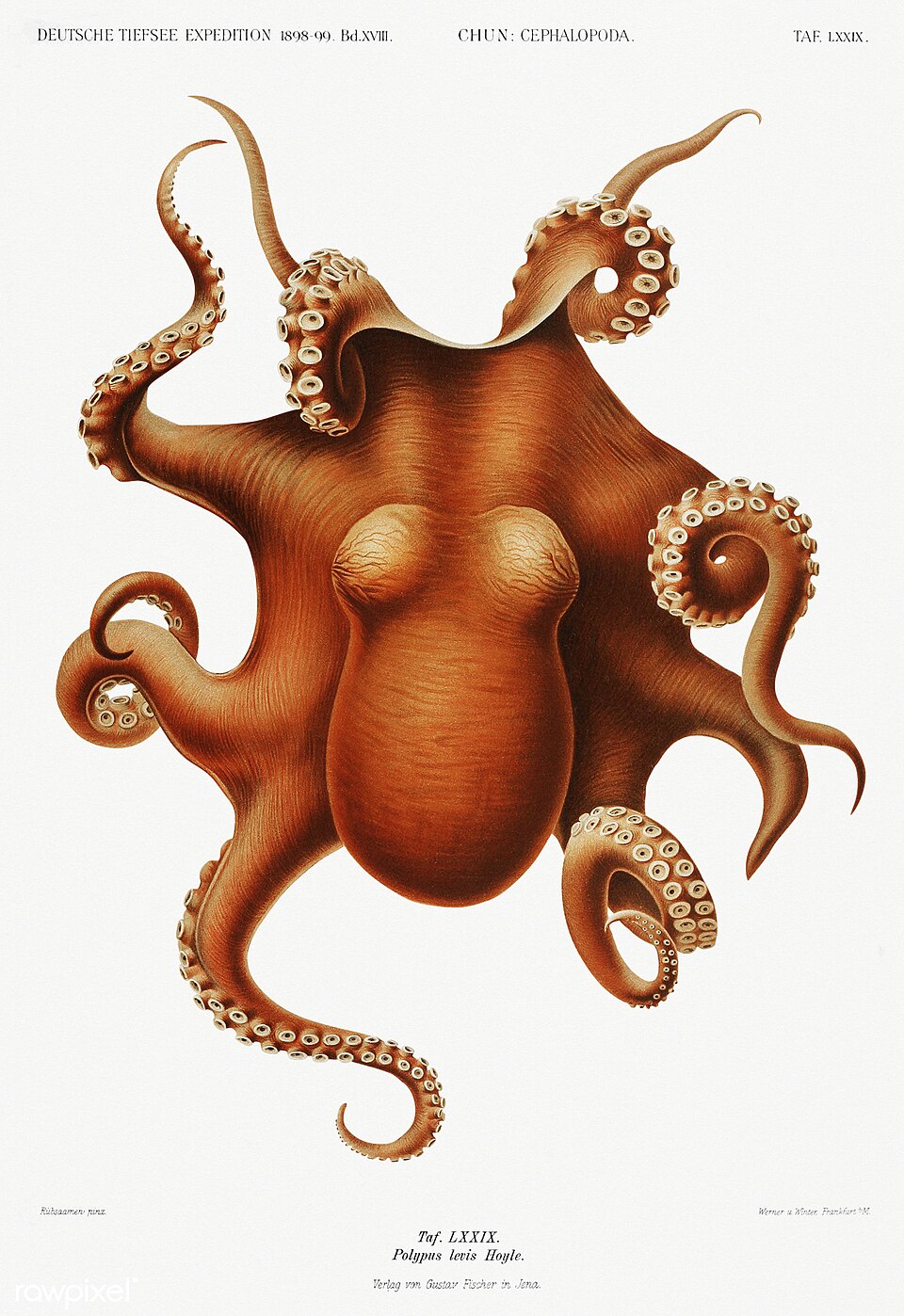
An octopus has approximately 500 million neurons. Two-thirds of them are in its arms, not its brain. Each arm has its own neural cluster, a ganglion, that can taste, touch, and make decisions without consulting the central brain. Cut off an octopus’s arm and it will continue to reach for food, recoil from threats, solve simple problems. For up to an hour.
Peter Godfrey-Smith calls this the deepest puzzle in the philosophy of mind: an organism in which the boundary of the self is genuinely unclear. Is the arm part of the octopus’s mind? Is the octopus one mind or eight? Three? The vertebrate answer (one brain, one self, one chain of command) simply does not apply.
The octotypic mind is not one mind freed from a shell. It is many partial minds in fluid negotiation.
Think about what this implies for the knowledge worker who has shed their exoskeleton. You are not a single professional identity that has become flexible. You are a loose federation of capabilities: some delegated to AI agents, some embodied in muscle memory, some contextual, activated only in particular environments. This setup feels much more natural, because it is what we are.
Modern tech, by automating much of the shell’s functions, is allowing us to get closer to our biology. We, like the octopodes, do not have an identity. We perform one contextually.
This is autopoiesis made visible. The octopus does not have a plastic mind that adapts to the world only to find itself in Fight Club — the flexibility that can become anything discovering it is nothing. Palahniuk’s novel as the canonical narrative of flexibility-as-crisis. Tyler Durden is what happens when the self that shed its shell has no beak. The octopus-and-its-environment is the cognitive system. There is no inner octopus observing an outer world and adjusting. The adjustments ARE the octopus. Our minds are octotypic.
Minimum Viable Rigidities and Mind Hives #
An octopus is essentially boneless. It can reshape itself completely, flow through crevices, mimic other species, become a coconut, become a rock, become a piece of drifting seaweed. But there is one hard part it cannot dissolve: the beak. A parrot-like structure of chitin, the hardest thing in its body. The smallest gap an octopus can squeeze through is exactly the width of its beak.
Even the most plastic organism has a minimum viable rigidity.
What is the beak of the octotypic mind?
Malabou would say: plasticity itself. The capacity for giving and taking form, which is itself non-negotiable. You can’t be plastic about your own plasticity without dissolving entirely. That way lies what she calls destructive plasticity: the plasticity that doesn’t create new forms but annihilates the capacity for form altogether. Alzheimer’s as the limit case. The subject becomes genuinely unrecognizable to itself.
I think the beak is something both simpler and harder to name.
It is not an identity but more an identity generator: Fascination. The octopus navigates by what it notices. Chromatophores respond to what they detect. Arms reach toward what interests them. Curiosity precedes identity. You do not need to know who you are to know what interests you. The dilettante has always known this. The word comes from the Italian dilettare, to delight.
The rangaku scholars were all fascination. They could not define their discipline but they could not stop creating temp identities to digest the Dutch texts arriving on Dejima. Hunayn ibn Ishaq at the House of Wisdom had a beak: the compulsion to translate, to move meaning between languages, regardless of what “field” the text belonged to.
In the coming years I posit that we will relate to each other not through our professional roles but through our complementary curiosities. Not a hive mind — mind hives. The AI layer will become our connective tissue. Something more like a shared external nervous system than an outsourced exoskeleton. Infrastructure that lets distributed, plastic, boneless minds find each other and coordinate without having to harden into crabs to do it.
We have been building civilizations on the vertebrate model for ten thousand years. The exoskeleton, the crab-shell of professional identity, institutional role, disciplinary boundary, is what happens when you try to make vertebrate-style centralized selves coordinate at scale. That architecture held for four centuries of industrialization. But nature is back. Life, uhh, found a way…
The octotypic mind is nature’s wager that flexible identity adoption is the best for surviving in angry nature. Societies have worked hard to remove nature and the associated cycles and complexities. With the internet we entered a zone where the core unit of nature, information, could rapidly complexify around itself. By pushing real nature out, we were able to feed a direct line to information so that complex interconnected ecosystems emerged. Note the use of choke points by info-predators: Underground Empire
With AI, our minds may find themselves in a more natural state than we expect.
Join the conversation moderated
No comments yet — start the conversation.
Replying to
Thanks — your comment is awaiting moderation.