The Viscous Frontier
How to Move When the Machine Stops Pulling
I. #
In May 1976 a Satawalese master navigator named Mau Piailug stood on the deck of a double-hulled Polynesian canoe in Honolua Bay, Maui, and prepared to sail to Tahiti. Sans compass, chronometer, and chart. The canoe was Hōkūleʻa, a replica of the voyaging craft that had carried Polynesians across the Pacific a thousand years earlier. Over the next thirty-four days Piailug would navigate her about two thousand three hundred nautical miles south-southeast to Papeete using the rising and setting positions of stars, the shape of ocean swells refracted off islands beyond the horizon, the colour of the water at dusk, and the behaviour of terns returning to land at evening.
No native Hawaiian had navigated a long-distance voyage without instruments in about six centuries. The practice had been lost in Hawai’i, forgotten in most of the Pacific, and preserved in only a few small Micronesian islands, including Satawal, where Piailug had learned it from his grandfather as a child. He carried the knowledge across cultures to a group of Hawaiians who had decided to recover it.
The voyage worked. The canoe arrived in Tahiti in the first week of June. Four years later Nainoa Thompson, trained by Piailug, navigated the return leg himself, the first native Hawaiian to do so in about six hundred years. Voyaging societies across the Pacific now teach wayfinding as a formal curriculum, and the practice is written into Hawaiian state school standards. Piailug died on Satawal on 12 July 2010. Thompson is still sailing. The Polynesian Voyaging Society now trains wayfinders as a structured apprenticeship recognised by the Hawai’i Department of Education.
II. #
At small scales, water does not behave the way it does in a bathtub. A bacterium moving through water experiences the fluid as molasses. If the bacterium stops pushing its flagellum, it stops moving within a microsecond, within a distance less than its own body. Inertia, at that scale, does not exist.
Edward Purcell proved something strange about this regime in 1977. Presented as a talk at the 1976 American Physical Society meeting honouring Victor Weisskopf; published as “Life at Low Reynolds Number” in the American Journal of Physics 45(1), pp. 3–11, January 1977. One of the great physics essays of the twentieth century, and the clearest. A swimmer at low Reynolds number cannot move by reciprocal motion. If you open and close a scallop shell, stroke forward and stroke back, you get zero net displacement. The scallop theorem: any symmetric motion in this regime produces no progress. To move you need an asymmetric stroke, a twist that cannot be undone by reversing it. The rotating flagellum is such a stroke. A paddle moved back and forth is not.
This is the physics Piailug was doing without naming. A wayfinder who reacts symmetrically to the ocean, correcting every wave, chasing every wind-shift, produces no net course. The swell that pushes the canoe off line tonight is matched by the swell that pushes it back tomorrow, and the integrated result is drift. To reach Tahiti, Piailug had to hold an asymmetric bias against the ocean hour after hour: keep the ENE swell on the port quarter, compensate for the trade-wind set by aiming ten degrees west of the star, ignore perturbations whose integrated effect averages to zero. The non-reciprocal stroke was his continuous attention to a few directional signals over all the others. The scallop theorem is not a metaphor for what wayfinders do. It is literally the reason they have to do it.
III. #
Modern culture used to work in the opposite regime. The Modernity Machine was a pull machine. It generated enormous cultural inertia in a single direction, toward Progress and canonical goals, and individual motion rode that inertia. You did not have to produce your own direction; you found yours inside the pull. A college education pointed at a profession, the profession at a career arc, and the arc ended at a pension. The whole apparatus was being pulled toward Progress by forces much larger than any individual intention. The person with an idea and no resources struggled. The person with no idea was still carried.
As the Divergence Machine was fully installed around the year 2000 (and the Liveness era was seeded), the pull stopped. It did not collapse at any specific date; it dispersed into a fan of available directions, each equally legitimate and none carrying gravitational weight. What remained was the infrastructure: the institutions, the credentialing systems, the career paths, the professional associations, running on momentum but no longer generating any. The machine kept moving. It stopped pulling anyone with it.
The felt experience of this, when you try to do anything directional in 2026, is viscosity. A career that would have carried you twenty years ago now requires continuous local work to move in any direction at all. The question is not how hard you are working. The question is whether the work has a non-reciprocal component, or is a scallop stroke.
IV. #
Most of what people call work in the current culture is scallop strokes. The attention economy is the most visible case. It is not lazy. It is energetic. An hour in a feed is an hour of real cognitive work, evaluating and reacting and filtering, and it produces nothing that survives the hour. The feed is different tomorrow; the work does not compound; nothing has been deposited. This is a dissipative structure: energy in, heat out, no accumulation of state.
Users spend on average about two and a half hours a day on social platforms. DataReportal’s Digital 2024 report gives 2h 23m average daily time on social platforms across about 5 billion users. The directional-attention fraction — the subset that could otherwise go to non-reciprocal work — is smaller and harder to measure, but the total is the ceiling. Across the roughly three billion active accounts that is on the order of two to three trillion hours of cognitive labour annually, none of which accumulates into anything the labourer can later claim as theirs. The platform keeps the product. The worker is paid in small returns of dopamine and social status, the way a bacterium is paid in small ATP increments for every flagellar rotation. The difference is that the bacterium’s rotation moves it forward.
This is the Brownian bath of the Divergence Machine. The attention economy is not a headwind you can lean against; it is the fluid you swim in, exerting small random forces on every swimmer in every direction. To ignore it is not to resist it. It is to be diffused by it. This is water.
Quiet quitting and lying flat are attempts to escape the bath by withdrawal, and they do not work for the same reason the scallop’s stroke does not work. Withdrawal is symmetric. You disengage; you re-engage when you need money or social contact; the net displacement is zero. The bath does not notice your absence, and your absence does not accumulate into a direction.
V. #
What does accumulate in the Divergence Machine is surprisingly specific. Across independent science, small protocol communities, craft and instrument cultures, revival trades, and off-platform knowledge projects, a single structural feature recurs. Every durable live zone in current culture, every place where individual intent produces something that lasts, has an architectural requirement that forces participants to leave an artifact.
CTAN, the TeX archive, has been accumulating versioned packages for thirty-four years; its upload form rejects submissions that lack documentation. Tiny Tapeout requires participants to commit RTL that will actually be fabricated on silicon, which means a design either passes design-rule checks and tapes out, or it does not. Mathlib, the Lean community’s formal mathematics library, rejects proofs that do not compile. ARAS, a network of amateur astronomers, requires every contributed stellar spectrum to be submitted in a specific calibrated format with a documented wavelength solution; the contribution cannot be faked by eyeball, and the resulting archive has been used for peer-reviewed astrophysics for twenty years. suckless.org, a small circle of Unix programmers, deliberately refuses to put settings files in its tools, so any behavioural change requires a patch that becomes part of the public archive.
The common pattern is not community, mission, or even quality. It is an architectural constraint that makes motion-without-deposit structurally impossible.
This is the flagellum. The artifact requirement is the non-reciprocal mechanism. Participation in these zones cannot be a back-and-forth stroke; the structure of participation forces an asymmetric commitment that leaves a trace, and the traces accumulate across contributors and across time. A thousand people each leaving a chip, a proof, a spectrum, a patch, a package, and the result is infrastructure more permanent than any single contribution.
Drug discovery has its analogues. The Structural Genomics Consortium has been depositing open chemical probes for orphan targets since 2004, nearly two hundred probes accessible to anyone, a layer of infrastructure no single pharmaceutical company would have built. SGC probes cover kinases, bromodomains, methyltransferases, and other chromatin-regulating targets. Each probe ships with a structurally related negative control that does not engage the target — a design choice that makes the deposit falsifiable and therefore useful. M4K Pharma works by a similar logic for paediatric cancer targets. These are the CTANs of the therapeutic area: architectural requirements that force a deposit which then functions as the field’s substrate.
The attention economy has the opposite architecture. It looks like active participation and leaves nothing behind. It is the scallop stroke at scale.
VI. #
The generalised practice of moving in a fluid that does not carry you, by leaving asymmetric committed artifacts, has an older name. It is wayfinding.
Piailug wayfound at the scale of weeks of voyage. The same physics operates at other timescales, one much longer and one much shorter, and both matter to anyone doing serious work in 2026.
The longer one first. In 2003 a postdoctoral researcher named Anne Carpenter, who split her time between a cell biology lab at the Whitehead Institute and a computer-vision lab across the river at MIT, began writing a piece of software to automate the tedious work of identifying cells in microscope images. The field at that moment was in love with target-based drug discovery: pick a protein, develop a small molecule that binds it, push the molecule through clinical trials. Image-based profiling, looking at what happened to cells under a microscope and asking whether the images themselves told you something useful about a compound, was unfashionable. Carpenter kept at it.
The software was called CellProfiler. Its first paper appeared in 2006. In 2016 Carpenter’s group, by then at the Broad Institute, published a protocol called Cell Painting, a systematic way of extracting about fifteen hundred morphological features from cells treated with any perturbation. The protocol explained how to stain six cellular compartments with multiplexed dyes, image them on a high-content microscope, and derive a high-dimensional fingerprint characterising each perturbation’s effect on cellular morphology. Still unfashionable; the field was still betting on targets.
In 2023 the same group released the JUMP Cell Painting dataset: more than five million images of cells treated with about a hundred and thirty-six thousand distinct chemical and genetic perturbations, contributed by a cross-pharma consortium, deposited openly, totalling about a hundred and fifteen terabytes. By that point image-based profiling had become the training corpus for the new generation of AI-driven drug discovery platforms, including the ones my own colleagues and competitors are building. Recursion Pharmaceuticals, now a multi-billion-dollar public company, runs on a stack built on top of the techniques Carpenter’s group had been iterating openly for twenty years. The field had caught up.
What Carpenter did, over twenty years, was the scallop theorem at a career scale. She held a direction the field did not value and compensated for every pull away from it by continuous corrective work. Every release of CellProfiler was a commitment that could not be retracted. Every iteration of Cell Painting was a deposit. The JUMP dataset is the arrival in Tahiti. There was no moment of conversion for the field, only a slow accumulation of artifact against which the competition had to measure itself, until eventually the competition was using her tools.
The shorter timescale is the one any working scientist knows now. A bench scientist in 2026 submits a query to a generative model (a protein-design model, a compound generator, an image-to-image predictor) and waits. The model returns a thousand candidates. Many are plausible. Most are not useful. Her job is no longer to generate candidates; the candidates are cheap. Her job is to pick.
Taste is the flagellum.
This is wayfinding at the scale of an afternoon. Ranking the thousand candidates by score and taking the top five is scalloping; nothing is deposited that a future self can use. Refusing the model’s top pick when it looks wrong, and pulling a fifth-ranked candidate forward because something in its biological context reads as the better move.
The two timescales are the same practice, both operating in Purcell’s physics.
VII. #
The attention economy and the engagement-farming platforms look, in 2026, like the culmination of the Divergence Machine’s capture of individual intent. They consume cognitive labour at a scale no prior dissipative structure has approached.
My wager is that they are transitional, not terminal.
A dissipative structure survives where it can out-recruit its alternatives for a limited resource. The limited resource is human intent, which is finite and metabolically expensive to produce, on the order of a few waking hours a day of the directional kind. When the alternatives are scarce, when the artifact-producing structures are hard to find and hard to enter, the attention economy wins by default. When the alternatives proliferate, when the Carpenters and Piailugs and CTANs and Mathlibs and the next hundred projects like them become legible and accessible, the yield per hour of captured attention falls below the yield available elsewhere, and swimmers defect.
A fair fraction of the next decade will be about who builds the alternatives faster than the platforms (TikTok, Instagram, YouTube Shorts, the next three that have not yet been named) can absorb them. This is not a question about consciousness or regulation. It is a question of architectural constraints, and of how many people are willing to pay the metabolic cost of swimming without a current. This essay, as part of the broader Contraptions Book Club, is an example.
In three years, if the argument is right, there will be visibly more functioning live zones in biotech, in software, in research, in craft, than there are now, and the attention economy’s cultural weight will be measurably smaller. If it is wrong, the dissipative structures will have absorbed the artifact-producing ones too, and the swimmers will continue to exert themselves without any net displacement. Which will be sad.
Piailug died in 2010. Nainoa Thompson, the student he trained in 1976, is alive and still sailing. The knowledge did not come back because anyone made it profitable. It came back because a small number of people decided to row the canoe at low Reynolds number until the direction held.
Coda #
The Divergence Machine framework, including the Modernity Machine and the Argument of Progress, is Venkatesh Rao’s; the essay assumes familiarity with his Contraptions writing on the topic, in particular “The Divergence Machine II”. The physical framework is Edward Purcell’s 1977 paper “Life at Low Reynolds Number” in the American Journal of Physics. The Hōkūleʻa history draws on the public record of the Polynesian Voyaging Society and on Sam Low’s Hawaiki Rising (2013). Anne Carpenter’s work on CellProfiler, Cell Painting, and the JUMP Cell Painting Consortium is available through the Broad Institute’s Imaging Platform and the relevant papers in Genome Biology (2006), Nature Protocols (2016), and Nature Methods (2024). The Structural Genomics Consortium and M4K Pharma are open-source drug discovery projects worth the reader’s time.
The live-zone examples in section V (CTAN, Tiny Tapeout, Mathlib, ARAS, suckless) come from a research pass across twenty-odd candidate projects.
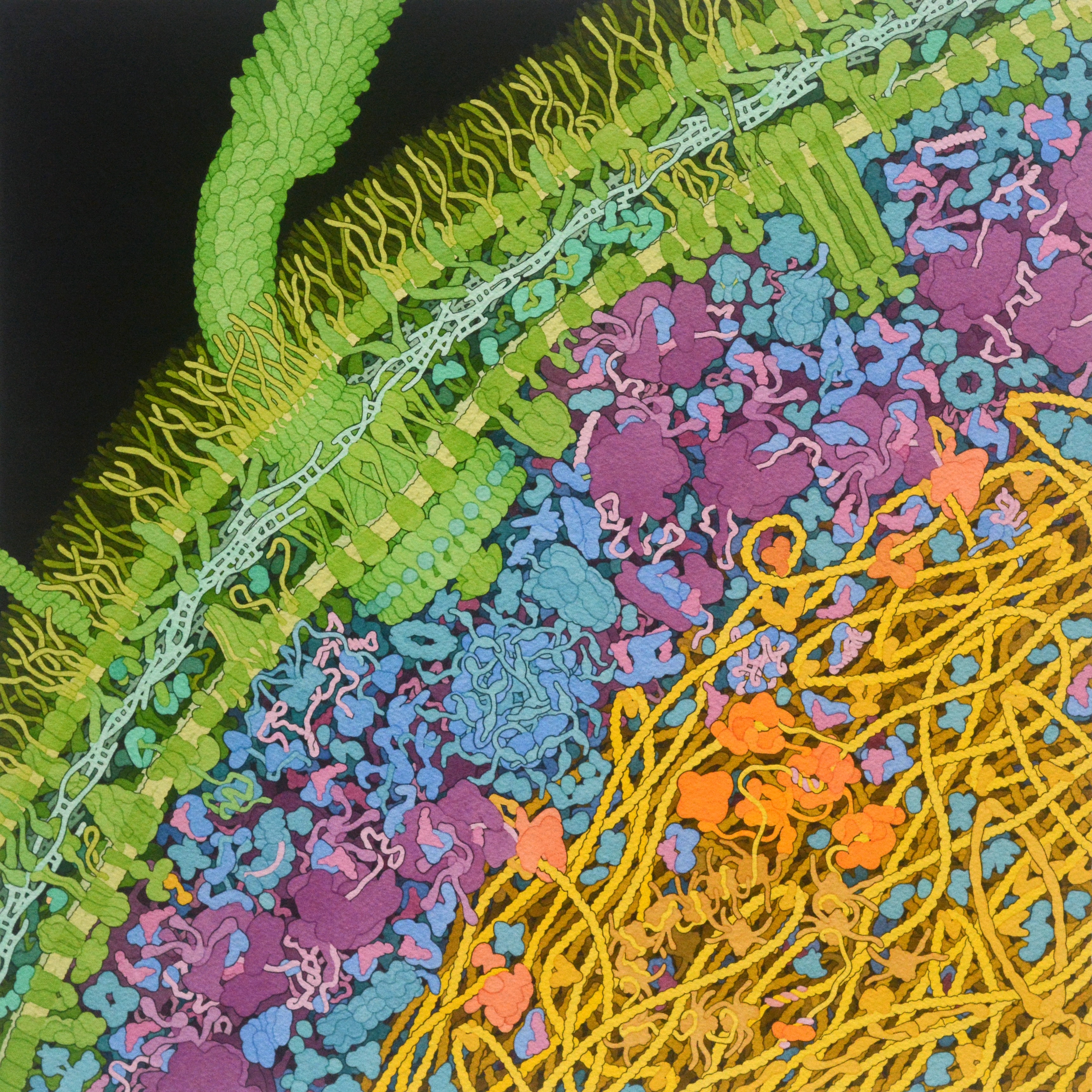
The image is Escherichia coli Bacterium (2021, revised 2022), illustration by David S. Goodsell, RCSB Protein Data Bank; doi:10.2210/rcsb_pdb/goodsell-gallery-028. Reproduced with attribution per the RCSB PDB sci-art gallery.
Join the conversation moderated
No comments yet — start the conversation.
Replying to
Thanks — your comment is awaiting moderation.